
Casmina’nın sanatı hakkında…
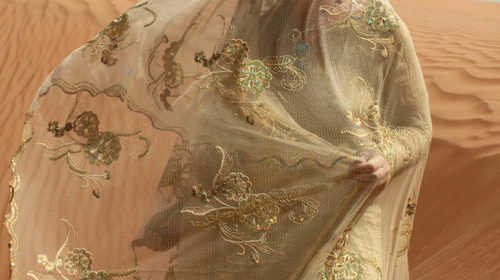
Sanatım hiçbir şey için mücadele etmiyor. Ders vermiyor ve soru sormuyor.Bilinmeyeni kucaklıyor.
Bu dünyaya getirdiğim şey bu, çünkü bana kendini bu şekilde gösterdi. Casmina
| Objects of Essence |
malzemenin temsil olmaktan ziyade varlık haline geldiği sürekli bir çalışma bütünüdür.
more
Altın, toprak, kül, pigment ve organik maddeler yoğun bir gerçeklik olarak var olurlar. Radikal indirgeme ve ilkel maddilik yoluyla, eserler zamanı, hareketsizliği ve maddeyi sessiz, tavizsiz bir varlığa yoğunlaştırır ve geriye kalanlara, kalıcı olanlara ve gerçek olana doğru içsel bir yansıma davet eder.
| Objects of Evolution |
dallar, tahıllar, saçlar ve yaldızlı kumlar aracılığıyla izlerini bırakırlar.
more
Büyüme ve dönüşümden, sürekli dönüşüm halindeki yaşamdan yumuşak bir şekilde bahsederler. Yaldızlı ve boyalı eserler, geçiciliği korur ve geçiciliği kalıcı bir varlığa dönüştürür. Bu şekilde, evrimin sessiz zarafetini somutlaştırırlar: hassas, kırılgan ve sürekli akan.
| Ready-Mades |
En içteki özüne, her yaratıcı dürtünün sessiz çekirdeğine yönelen bu sanatta, Ready-Mades ince ama derin varlık halleri olarak ortaya çıkar.
more
Alışılmış bağlamlarından kurtulan unsurlar yeniden görülür ve yeniden değerlendirilir. Özün çıkarılmasıyla, uykuda olan zarafet ve haysiyet ortaya çıkar. Derinlik açığa çıkar ve her şeyi birbirine bağlayan görünmez bağlantılar için alanlar açılır.
| Objects of Evolution | from Dr. Peter Funken | curator, art journalist, author | Berlin
The art of Casmina Magdalena Haas comes into existence through cooperation with nature – it needs bright light and natural substances and materials. But it also needs the spirit – and only by this the artwork comes into being.
more
The artist assembles her illustrative creations and objects with materials consciously collected in nature and used for her works of art. Those are woods, fir and pine needles, bamboo and seaweed, various cereals, like rye, wheat and millet, as well as rice, lentils and amaranth, in addition to sand. The artist always uses grown materials – not objects which have been made. Casmina composes her complex objects and picture creations of the comprehensive series of works called ‘Objects of Evolution’ with this kind of material. She uses the materials collected in nature in order to gold-plate or color them in the further process of picture-making. This way view plates of contemplation and spiritualization develop. Her work always moves between the poles of materialization and dematerialization, as well as inside an area of conflict between concrete form finding and the sublimation of matter in the sense of a spiritual experience. During the work process Casmina mainly develops monochrome surfaces, which as all-over structures follow the characteristics of the shape and expression of the used natural material. That way a picture produced from rice grain in pure white shows a surface structure of a fine, even grain, which consequently collects and reflects light evenly. But such work doesn’t only consist of the surface, in fact its side frames are also featured with applied rice and the binding color. The result is a three-dimensional picture object, a picture body with a light and color volume, whose corners are softly rounded due to the applied material. With this work and comparable works the image of an object in space develops, whose form does not know sharply drawn bounds, but seems to be floating in front of the wall and in the room, as the volume of the picture pushes into the room. In contrast to common paintings such a picture shape refers to its real shape and the tangible matter from what it derived. Hence the works of the artist can be called matter-objects, as they exhibit real-abstract as well as spiritual-contemplative characteristics.
Thus art becomes a method to gain reality and to make insights into processes of nature and work visible and to impart these. Furthermore, this means for the art of Casmina that nature relations which she realized migrate into her artwork during the diligate process of her work. There they exist permanently. A non-terminable, inherent relationship exists between the artistic act, which means the creation of a picture panel or a material-object, and the final outcome of the artwork. The artist describes this relationship with her words, as she expresses that the point of her art is to see the new in order to create the new. In this sense Casmina M. Haas works as a generalist – she engages herself with the newest findings in natural sciences as well as with old philosophy, direct nature observation and meditative contemplation.
In the sense of art sciences her works of the series ‘Objects of Evolution’ can primarily be allocated in two respects; they touch aspects of the trend of the so-called ‘Sublime Painting’, as it was presented thru the abstract paintings of American artists like Barnett Newman, Mark Rothko or Mark Tobey in the 50s and 60s of last century. They also touch the ways of perception, which were created by artists of the group ZERO and the Nouveau Realisme in Germany and France at about the same time. You can almost talk about a continuation of the shown approaches , who – as it can easily been seen thru the work of Casmina M Haas – can open up many aesthetic possibilities based on meditative-sensual and precise-artistic actions up until the present time.
It has to be added that the artist ties into much older images of art with her attraction by gold as color and material. Thus are the the medieval panel paintings, which we encounter at Masaccio or Stefan Lochner – the point is the golden background as holy and heavenly material, which indicates the aura of divinity, in which the scene, like the worship of the Christ child, takes place. The landscape as background has developed later in time. Later, in modern times and in the art of the 20th century gold as a material was used sparingly, primarily by Yves Klein, the main representative of the Nouveau Realisme, and thru his attraction to mysticism and spirituality. Like Yves Klein Casmina M. Haas uses gold foil for her labor, thus a precious material liberated from its weight in touching immanence. Due to the application of gold in her art something absolute is created, ideal beautiful and preciously magnificent. A greater number of the creations of the artist however is finished with white pigment. Thus are those who have cereals and tree needles as basic material. The color white engages thru its purity, it appears as timeless objective and leverages picture surfaces to a special clarity and distinguished brightness.
With her precise Orientation of the relationship of nature material and concrete arrangement Casmina has developed her distinctive own style. This style is created thru the sensitive use of nature material and the serial arrangement of woods and other matter. With the reduction to a few, but formal expressive stylistic features Casmina s able to produce striking and impressive picture works and objects. Their picture language is not culturally bound, as the artist first of all has confidence in the expressiveness and profile of the natural material she uses. She arranges these with her own artistic sensibility within the picture space and only then makes these perceptible as artefacts.In view of such a perception of natural material in artwork Casmina is primarily interested in personal interpretations of the effective forces of the living and natural – like the elementary powers of nature. Mankind was, has and will be always dependent upon these, despite all technical comforts. Following this notion Casminas works of the work series ‘Objects of Evolution’ point to the unlimited vitality which our planet owns in a mysterious way . It creates and takes life in an eternal process. These processes become clearly apparent and noticeable in her material-objects and pictures. They seem to be inscribed into her works and indicate as well the attitude and position the artist has to nature, which can be seen in her works as something adorable, almost sacred. This demonstration of her own, artistic position calls for a personal reaction, an attitude and engagement of the viewers, who encounter her works.
This happens in the work of Casmina in great clearness, using the possibilities of art and composition, thus in a direct way, which applies to the intellect and sensation and therefore opens up universal possibilities.
Reflections on the work of Casmina Magdalena Haas | S.Troy
Certainly to see enlightened things, not the light. | Goethe, Pandora
The beauty has a precarious state in art today.
more
At a time when beauty as the smooth and pleasing has permeated all life and thing worlds and perfect surfaces cover our existence, art seems suspicious with every movement of the beautiful to make: With the beautiful appearance and merely decorative, which is based on aesthetic enjoyment and quick consumption, it seems to be as incompatible as the unreflected return to an – as tempting as delicate – idea of beauty as one with true and good related appearance is denied.
If in recent times in the philosophical aesthetics and also in the feature pages there have been isolated pleadings for a “salvation of the beautiful” (Byung-Chul Han 2016), this resumption of a supposedly abandoned category must therefore make you listen. It is characterized by shared experiences of an absence of meaning or the deprivation of that which is true and good and (again) focuses on a concept of beauty as an expression of an unavailability. Their design and experience in the medium of art, it is expected, can guide a different way of seeing and possibly also experience moments of the unavailable in other areas of life – in thinking, political or religious – in the work of Casmina Magdalena Haas in a first approximation, it is not primarily about making beautiful things. Rather, their concern and constant theme seems to be to highlight the beautiful in things. In various media formats – whether in photography, painting, plastic or readymade – everything is shown that is already present in the found natural and
cultural objects as well as in the materials and also in the carrier medium itself. In the salvage of the inalienable beauty of the respective object, something that appears in the individual work appears at the same time (Haas calls this “embodied essence”) without being revealed. This principle of representation is exemplified in a “ at the beginning the light “installation is clear. On the photograph of freshly laid turtle eggs inserted into a gold-plated honeycomb frame, these are not immediately recognizable as such. The cut-out close-up of the nest does not reproduce the eggs with naturalistic sharpness. The photographic view does not expose them, but shows the milky-appearing round eggs in their delicacy in their being embedded and resting in themselves. In this way, the careful view of things and the world itself becomes thematic. In other words, the salvation of her beauty takes place in the conveyance of her security. This mediation work also always focuses on that “something” that appears in the individual work and eludes it at the same time. His withdrawal – his unavailability – is depicted as such in the art of Casmina Magdalena Haas: The golden color that recurs in many of her works, which half covers the photograph with uneven plastic paint application, refers to everything Access Withdrawal, to a beauty of a different, higher kind. Haas designs this interweaving of diaphanem and latencies in various variations and thus enables the experience of a closeness-distance, which is perhaps comparable to the experience of the sacred. The mystic Simone Weil described the quiescent, non-intentional experience of the beautiful in this sense as a gateway to the experience of the divine, as “a kind of incarnation of God in the world”: “The beautiful is what one desires without wanting to consume it. We desire that it be. ”
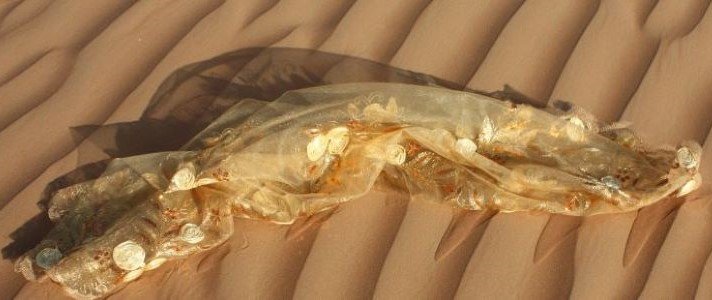
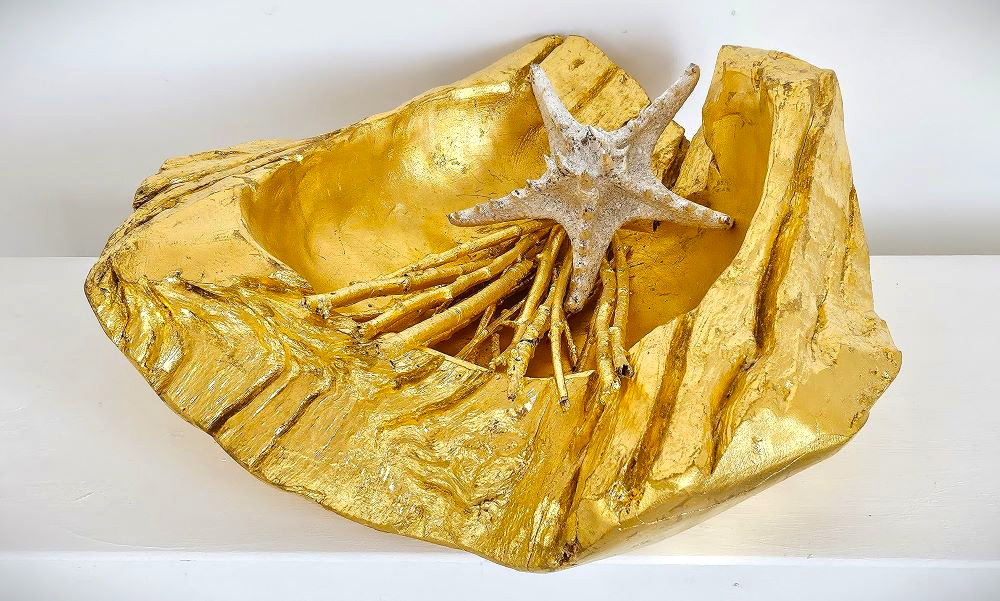
This erotic and at the same time keeping a distance view of the world is particularly expressed in Haas ’“ objects of evolution ”. The natural materials attached to canvas or wood – rice and cereal grains, pine needles, twigs and woods, hair, wax, sand and various soils – are carefully arranged and seem to have grown up in their respective composition. In their physicality and reduction to one natural material each, they appear as organic life forms, as if nature had organized itself into a work of art. These “objects of evolution” present themselves as variations on the same subject, namely the careful emphasis on “natural beauty”, as is also the case for a group of works made from different woods. They refer to a mystery, to that impenetrable ‘something’ that shines in the individual nature installations to a certain extent. This afterglow is also manifested in the “objects of evolution” in the gold leaf material with which they are partially completely covered. The value of the material gold expresses an appreciation of the gilded natural objects. The gilding also highlights the materiality and sensuality of the natural materials from which the pictures or installations are made, also by virtue of the light reflections they generate, and at the same time deprives them of the eye’s direct analytical access. The “objects of evolution” thus indirectly reflect a kind of indirect immediacy. In other words, the artist addresses that other seeing that can perceive meaning in the sensual, light in the enlightened. Simone Weil aptly wrote about such an unintentional view of art and natural beauty that one had to “look at it until light breaks out”. In the gloss of the body, which the artist highlights in her multifaceted work, a common visual habit of hidden light emerges – and is at the same time restored in its unavailability and as a secret. The motif of the veil can therefore be central to Haas’ work to be viewed as. Whether through the use of semi-transparent paper and gauze bandages in her mixed media works, wax and opaque oil paints or textured layers of gold and gold leaf: the artist’s works give something to see by not showing it entirely. If an installation made of vertically arranged branches and covered with a layer of oil and wax like a cloth is called “behind the veil”, then the title seems to reflect on it, namely the depiction of a ‘behind’ as last removed and unavailable . In this rhythm of concealment and concealment, immanence and transcendence, sensuality and meaning, a game takes place with increasingly unstable dualities that seem to expand into a space of threshold that we humans inhabit. It therefore only makes sense that in a series of captivatingly beautiful photographs taken in the Wahiba Desert, the artist herself is hiding behind a veil.