
Artistic Ouvre
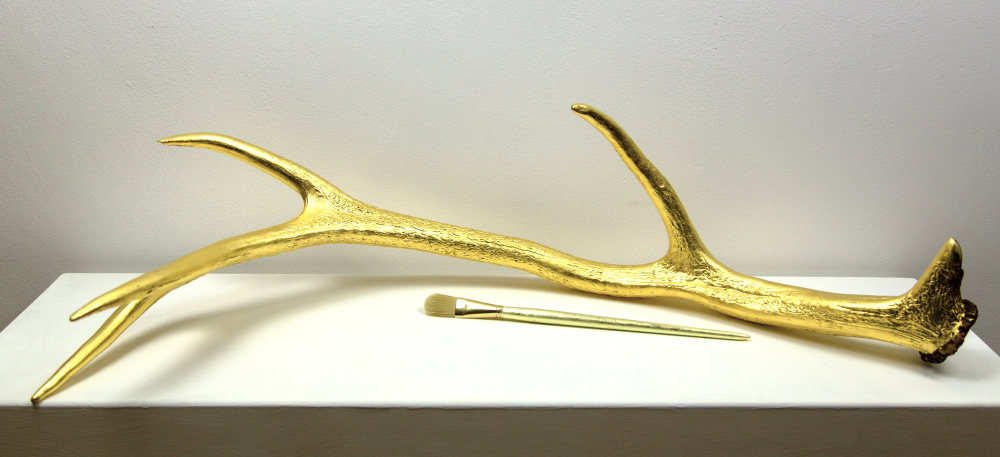 | The Source | 2020
Geweih – vergoldet, Pinsel – vergoldet | 2020 born in Berlin
My art doesn’t fight for anything. It doesn’t lecture or ask questions. It embraces the unknown.
That’s what I bring to this world, because that’s how it revealed itself to me. Casmina
| Objects of Essence |
The Objects of Essence constitute an ongoing body of work comprising approximately fifty objects, in which material functions less as a means of representation than as presence itself. Gold, earth, ash, pigments, and organic substances exist as condensed realities, asserting their own intrinsic materiality.
more
Gold, earth, ash, pigments, and organic matter exist as a dense reality. Through radical reduction and primordial materiality, the works condense time, stillness, and matter into a silent, uncompromising presence, inviting an inner reflection toward what remains, what is enduring, and what is real.
| Objects of Evolution |
They witness traces of becoming through branches, grains, hair, and gilded sand.
more
They expose gently of growth and the depth of transformation, of life in its constant change. These gilded and painted works preserve transience and transform impermanence into an enduring presence. In this way, they embody the quiet grace of evolution: delicate, fragile, and ever-flowing.
| Objects of Art |
Created using gold and other precious metals on the surface, they unite the elemental forces of art with professional artistic expertise.
more
Light becomes matter, and matter becomes a vessel for an intrincic elemental wisdom.Each artwork is a quiet exploration of permanence, transformation, the invisible essence that holds all things together. The precious metals do not merely adorn the surface; they embody time, the unknown, and uncompromising presence. By harmonizing material wealth with contemplative depth, tne Objects of Art invite the audience into a sphere within silence where beauty reveals itself as something timeless, sacred, and everlasting.
| Objects of Matter |
In this art the Objects of Matter emerge as subtle yet profound states of being.
more
Elements freed from their usual contexts are new seen and re-evaluated. By extracting the essence, dormant grace and dignity are revealed. Depth is uncovered, and spaces are opened for the invisible connections that bind everything together.
| Casmina Magdalena Haas, Objects of Evolution and Matter and other artworks |
by Dr. Peter Funken | Author, Artjournalist, Curator | Berlin
The art of Casmina Magdalena Haas comes into existence through cooperation with nature – it needs bright light and natural substances and materials. But it also needs the spirit – and only by this the artwork comes into being.
more
The artist assembles her illustrative creations and objects with materials consciously collected in nature and used for her works of art. Those are woods, fir and pine needles, bamboo and seaweed, various cereals, like rye, wheat and millet, as well as rice, lentils and amaranth, in addition to sand. The artist always uses grown materials – not objects which have been made.
Casmina M. Haas composes her complex objects and picture creations of the comprehensive series of works called ‘Objects of Evolution’ with this kind of material. She uses the materials collected in nature in order to gold-plate or color them in the further process of picture-making. This way view plates of contemplation and spiritualization develop.
Her work always moves between the poles of materialization and dematerialization, as well as inside an area of conflict between concrete form finding and the sublimation of matter in the sense of a spiritual experience.
During the work process Casmina M. Haas mainly develops monochrome surfaces, which as all-over structures follow the characteristics of the shape and expression of the used natural material. That way a picture produced from rice grain in pure white shows a surface structure of a fine, even grain, which consequently collects and reflects light evenly. But such work doesn’t only consist of the surface, in fact its side frames are also featured with applied rice and the binding color. The result is a three-dimensional picture object, a picture body with a light and color volume, whose corners are softly rounded due to the applied material. With this work and comparable works the image of an object in space develops, whose form does not know sharply drawn bounds, but seems to be floating in front of the wall and in the room, as the volume of the picture pushes into the room. In contrast to common paintings such a picture shape refers to its real shape and the tangible matter from what it derived. Hence the works of the artist can be called matter-objects, as they exhibit real-abstract as well as spiritual-contemplative characteristics.
Thus art becomes a method to gain reality and to make insights into processes of nature and work visible and to impart these. Furthermore, this means for the art of Casmina M. Haas that nature relations which she realized migrate into her artwork during the diligate process of her work. There they exist permanently. A non-terminable, inherent relationship exists between the artistic act, which means the creation of a picture panel or a material-object, and the final outcome of the artwork. The artist describes this relationship with her words, as she expresses that the point of her art is to see the new in order to create the new. In this sense Casmina M. Haas works as a generalist – she engages herself with the newest findings in natural sciences as well as with old philosophy, direct nature observation and meditative contemplation.
In the sense of art sciences her works of the series ‘Objects of Evolution’ can primarily be allocated in two respects; they touch aspects of the trend of the so-called ‘Sublime Painting’, as it was presented thru the abstract paintings of American artists like Barnett Newman, Mark Rothko or Mark Tobey in the 50s and 60s of last century. They also touch the ways of perception, which were created by artists of the group ZERO and the Nouveau Realisme in Germany and France at about the same time. You can almost talk about a continuation of the shown approaches , who – as it can easily been seen thru the work of Casmina M Haas – can open up many aesthetic possibilities based on meditative-sensual and precise-artistic actions up until the present time.
It has to be added that the artist ties into much older images of art with her attraction by gold as color and material. Thus are the the medieval panel paintings, which we encounter at Masaccio or Stefan Lochner – the point is the golden background as holy and heavenly material, which indicates the aura of divinity, in which the scene, like the worship of the Christ child, takes place. The landscape as background has developed later in time. Later, in modern times and in the art of the 20th century gold as a material was used sparingly, primarily by Yves Klein, the main representative of the Nouveau Realisme, and thru his attraction to mysticism and spirituality. Like Yves Klein Casmina M. Haas uses gold foil for her labor, thus a precious material liberated from its weight in touching immanence. Due to the application of gold in her art something absolute is created, ideal beautiful and preciously magnificent.
A greater number of the creations of the artist however is finished with white pigment. Thus are those who have cereals and tree needles as basic material. The color white engages thru its purity, it appears as timeless objective and leverages picture surfaces to a special clarity and distinguished brightness.
With her precise Orientation of the relationship of nature material and concrete arrangement Casmina M. Haas has developed her distinctive own style. This style is created thru the sensitive use of nature material and the serial arrangement of woods and other matter. With the reduction to a few, but formal expressive stylistic features Casmina M. Haas is able to produce striking and impressive picture works and objects. Their picture language is not culturally bound, as the artist first of all has confidence in the expressiveness and profile of the natural material she uses. She arranges these with her own artistic sensibility within the picture space and only then makes these perceptible as artefacts.
In view of such a perception of natural material in artwork Casmina M. Haas is primarily interested in personal interpretations of the effective forces of the living and natural – like the elementary powers of nature. Mankind was, has and will be always dependent upon these, despite all technical comforts.
Following this notion Casmina M. Haas works of the work series ‘Objects of Evolution’ point to the unlimited vitality which our planet owns in a mysterious way . It creates and takes life in an eternal process. These processes become clearly apparent and noticeable in her material-objects and pictures. They seem to be inscribed into her works and indicate as well the attitude and position the artist has to nature, which can be seen in her works as something adorable, almost sacred. This demonstration of her own, artistic position calls for a personal reaction, an attitude and engagement of the viewers, who encounter her works.
This happens in the work of Casmina M. Haas in great clearness, using the possibilities of art and composition, thus in a direct way, which applies to the intellect and sensation and therefore opens up universal possibilities.
| Upon the glow of Bodies. Reflections on the work of Casmina Magdalena Haas |
by Dr. Sarah Scheibenberger | Author, Translater and Lecturer of Literature and und Aesthetics | Berlin
Determited, what is illuminated, not the light itself. | Goethe, Pandora
more
When, in recent times, isolated calls to save the beautiful have been heard in aesthetic discourse, this revival of an almost abandoned category must catch our attention. It is marked by common experiences of an absence of meaning, of the withdrawal of that which is true and good, and highlights a concept of beauty as an expression of unavailability. The expectation is that its articulation and experience through the medium of art can guide a different way of seeing and enable us to perceive moments of the unavailability in other spheres of life as well – in thought, in politics, and in religion.
Casmina Magdalena Haas’s work is not primarily concerned with the creation of beautiful things. Rather, her concern and recurring theme seem to be the revelation of beauty in things. Through various media formats – whether photography, painting, sculpture, or readymades – she reveals what has always been present in the found objects of nature and culture, as well as in the materials and the medium itself. In the act of uncovering the inalienable beauty of each object, “something” simultaneously emerges (Haas herself calls it “Embodied Essence”), which comes to light in the individual work without being fully revealed.
This principle of representation becomes clear in an installation titled “In the Beginning Was the Light.” In the photograph of freshly laid turtle eggs set within a gilded honeycomb frame, the eggs are not immediately recognizable as such at first glance. The close-up detail of the nest does not render the eggs with naturalistic sharpness. The photographic gaze does not merely depict them but, in a delicate blur, shows the milky-appearing round eggs as they are nestled and at rest within themselves. Thus, the gentle gaze upon things and the world itself becomes the central theme. In other words, the revelation of their beauty takes place through the conveyance of their sense of security.
This act of conveyance always also highlights that “something” which emerges in the individual work while simultaneously eluding it. Its elusiveness – its unavailability – is depicted as such in the art of Casmina M. Haas: The golden color that recurs in many of her works – covering half the photograph with an uneven, sculptural application of paint – points to something that eludes all grasp, to a beauty of a different kind.
In a wide range of variations, Haas shapes this interplay of visibility and concealment, thereby enabling the experience of a closeness-distance that is perhaps comparable to the experience of the sacred. The mystic Simone Weil described the seemingly self-contained, unintentional experience of beauty in this sense as a gateway to the experience of the divine, as “a kind of incarnation of God in the world”: “Beauty is that which one desires without wishing to consume it. We desire that it be.”
This erotic yet distanced view of the world is particularly evident in the “objects of evolution.” The natural materials affixed to canvas or wood – rice and grain kernels, pine needles, twigs and pieces of wood, hair, wax, sand, and various types of earth – are carefully arranged and, despite their composed nature, seem as if they had grown there.
In their physicality and reduction to a single natural material, they appear as organic life forms, as if nature itself had organized itself into a work of art within them. These “objects of evolution” present themselves as variations on the same theme – namely, the gentle highlighting of “natural beauty,” as a group of works made from various types of wood is also titled. They point to a mystery, to that impenetrable “something” that, in a sense, glows within the individual natural installations.
This glow manifests itself in the “Objects of Evolution” through the material gold leaf, with which they are partially – or in some cases completely – covered. The value of gold as a material expresses an appreciation for the gilded natural objects. The gilding – partly through the light reflections it creates – highlights the materiality and sensuality of the natural materials from which the images or installations are crafted, while simultaneously withdrawing them from the eye’s direct, analytical scrutiny. The “Objects of Evolution” reflect a kind of indirect immediacy. They explore that alternative way of seeing which is capable of perceiving meaning in the sensual, light in the illuminated. Simone Weil aptly wrote about such an unintentional gaze upon the beauty of art and nature, stating that one must “look at it until light bursts forth.” In the radiance of the bodies, which the artist emphasizes in her multifaceted body of work, a light emerges that remains hidden from conventional ways of seeing. It is restored in its inaccessibility and as a mystery.
The motif of the veil can therefore be considered central to the work of Casmina M. Haas. Whether through the use of semi-transparent papers and gauze bandages in her mixed-media works, or of wax and opaque oil paints, or layers of paint and gold leaf applied texturally: the artist’s works reveal something precisely by not showing it in its entirety. When an installation of vertically arranged branches, veiled with a layer of oil and wax as if with a cloth, is titled “behind the veil,” the title seems to reflect precisely this – namely, the depiction of a “behind” that is ultimately withdrawn and inaccessible. Within this rhythm of revelation and concealment, immanence and transcendence, sensuality and meaning, a play unfolds with increasingly unstable dualities that seem to expand into a liminal space inhabited by us humans. It therefore stands to reason that in a series of photographs taken in the Wahiba Desert, te artist herself reveals-conceals herself behind a veil.